AI is no mere flash-forward scene from a sci-fi flick. Today, it stands as a potent catalyst for change, redefining the contours of scientific exploration. The erstwhile lumbering pace of research is seeing an unprecedented acceleration, powered by advanced algorithms.
From complex data analysis in advanced research undertakings to predictive modeling in classrooms, AI disrupts the old order, setting the stage for a new era of accelerated scientific breakthroughs and engaging STEM education. Tieing your lab coat or strapping your school backpack, brace yourselves to delve into an exciting world where AI takes the steering wheel of scientific discovery and learning.
AI: The Catalyst for Breakthroughs in Science
Imagine trawling through a sea of information, each strand of data as intricate as the next, searching for a singular pattern that could revolutionize our understanding of the universe. This was once the daunting task for scientists, a task riddled with human bias and cognitive limitations. AI, however, unfazed by these challenges, is powering through vast datasets, discerning hidden patterns, and streamlining repetitive tasks with ease.
Take the case of drug discovery. Previously, it took scientists years, even decades, to identify promising compounds for further investigations. AI, deciphering complex molecular structures, now makes short work of this process. Progress in material science too has been expedited thanks to AI’s ability to analyze combinations of elements, predicting their behavior in vastly different conditions. Even in climate modeling, AI’s ability to crunch enormous data sets helps us understand, and potentially mitigate, the looming threats of climate change.
Whether it’s shaking up established norms or busting through cognitive limitations, the onset of AI in scientific research has paved the way for breakthroughs that were previously out of reach. Although one might argue that AI reduces the human touch in research, the potential benefits far outweigh any apprehensions. As researchers and students alike harness the power of AI, we stand on the cusp of a new era of discovery and education, a testament to the transformative power of technology. AI, we’d argue, isn’t stealing the show; it’s simply making the act of discovery more precise, efficient, and inclusive.
AI in Predictive Modeling: From Climate to Cosmos
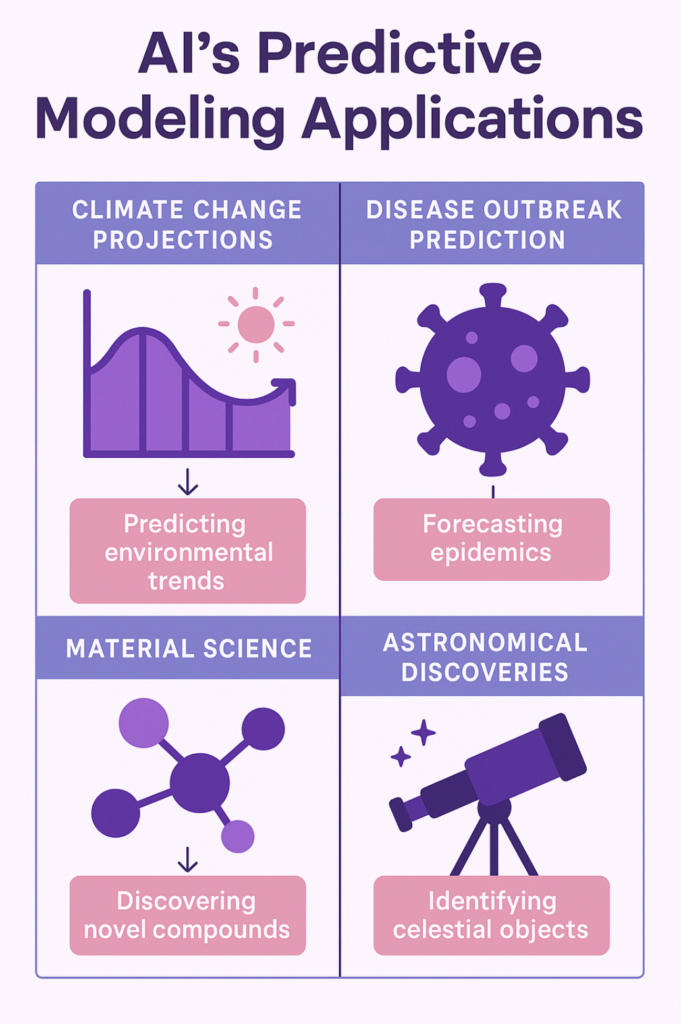
1. Climate Change Projections: With algorithms far outpacing traditional analysis, AI is an invaluable resource for the fight against climate change. By sifting through volumes of meteorological data, it can forecast weather patterns and estimate sea-level rise with impressive precision.
2. Disease Outbreak Forecasting: AI doesn’t only predict, but prevents too. When it comes to disease control, it can analyze health data, identify risk factors, and map possible infection spread, thereby allowing us timely interventions.
3. Material Science: In this sphere, AI is almost like a prescient chemist. Predicting the properties of undiscovered compounds, it accelerates the pace at which we innovate materials, fostering technological growth.
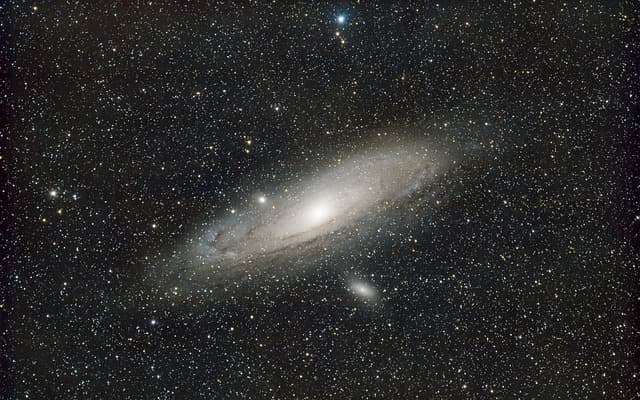
4. Astronomical Discoveries: Mapping the cosmos is no small task, but AI is up to it. Even as we sleep, algorithms are combing through colossal datasets, identifying celestial occurrences like exoplanets and gravitational waves.
Each of these predictive capabilities of AI lends a unique strength to scientific endeavors, cutting through complexities far more efficiently than conventional methods ever could. It paints a future where humanity can respond to challenges preemptively and synthetize solutions at a rate previously unthinkable.
Unraveling Proteins with AI: The AlphaFold Story
Have you ever pondered about the mysteries of life at a molecular level, where complex proteins twist and turn into mind-boggling configurations? Imagine if we could predict, with a high degree of accuracy, these protein structures – it’d be akin to having a blueprint of life itself! This is the conundrum that awaited scientists for decades; until AI stepped in with AlphaFold.
Proteins, the working machinery of life, are notoriously hard to map. Decoding their structure through conventional means, usually crystallography or cryo-electron microscopy, is a time-consuming and expensive process.
Enter AlphaFold, an AI model developed by DeepMind. It unraveled this dilemma by computing a protein’s 3D structure from its amino-acid sequence. The system utilizes an attention-based neural network architecture to model pairwise residue interactions and predict protein structures.
This is monumental. AlphaFold has far surpassed previous predictive models in the Critical Assessment of protein Structure Prediction competition. Scientists across the globe can now gain valuable insights into protein structures, opening new possibilities for drug discovery, biofuel development, and a host of other applications. The beauty of AlphaFold’s accomplishment lies not only in the results but also in the method – a clear illustration of how AI can revolutionize scientific discovery.
In a nutshell, AlphaFold used AI to solve a 50-year-old challenge. It sounds like the stuff of science fiction, yet it’s stark reality. Our understanding of the building blocks of life just took a quantum leap forward, all thanks to a bit of AI-driven ingenuity.
AI: A New Dimension to Science Education
Dream of a world where even a high school student can power predictive modeling or decode convoluted protein structures like a seasoned scientist. Fantastic as this vision may seem, it’s closer to reality than you may think, thanks to the blossoming intersection of AI and science education.
AI isn’t an exclusive playground for advanced researchers anymore. Instead, it has a burgeoning role in democratizing complex scientific concepts, making them accessible and interactive for learners of all levels. To put science education into perspective, AI is akin to a 21st-century magnifying glass. Using this tool, both the macroscopic mysteries of our universe and the microscopic wonders locked within molecules become tangible, graspable subjects of exploration.
Bypassing traditional constraints of textbooks and lectures, AI poses as a new-age tutor. It’s a silent guide that facilitates an inquisitive and hands-on approach to learning. Be it using machine learning to analyse big data or crafting predictive models, AI-powdered platforms are bridging gaps between theory and practicality. They foster a deeper understanding by transforming science education from passive learning to active discovery.
Imagine, for example, a student grappling with the vagaries of drug design or the mysteries of uncharted compounds. AI doesn’t merely arm the student with theoretical knowledge. Instead, it encourages the student to dive deep, to manipulate variables and examine outcomes, providing a virtual hands-on experience.
Yet, adoption of AI in science education is not just about high-level exposure or demystifying complexity. It’s also about engagement. Interactive AI tools make learning experiential rather than exam-driven, sparking curiosity among younger generations.
However, blanket adoption of AI should proceed with caution. As valuable as AI can be for education, we must remember to teach not just about its uses but also its ethical considerations. Only then can it truly revolutionize not just what we learn but also how we learn. This inclusive approach ensures tomorrow’s scientists are both keen and ethical, marking a new frontier for the application of AI: science education for everyone, irrespective of age.
Charting the AI in Education Landscape
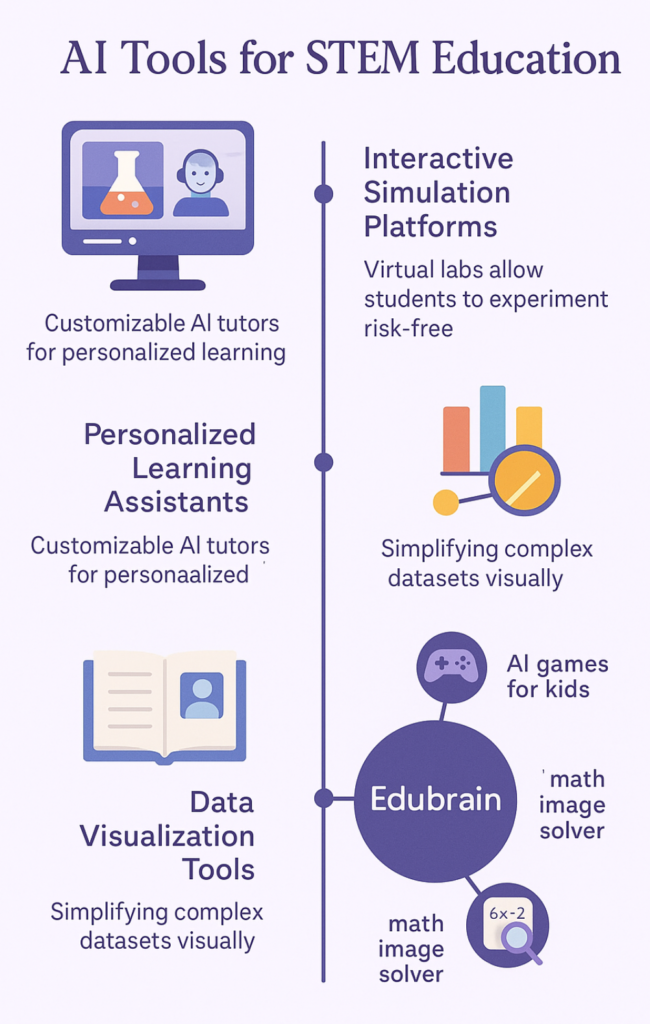
Science can be complex, challenging to grasp, and at times, downright intimidating – especially for students who are just beginning to explore this vast domain. Enter AI, a pivotal player in making science education more amenable, enjoyable, and interactive for budding learners. Let’s take a whirl through a selection of AI tools reshaping the educational landscape:
- Virtual labs come to life thanks to Interactive Simulation Platforms powered by AI. Students have the luxury of conducting experiments, watching theory transform into reality, all from the comfort of their study desks.
- Catering to individualistic learning patterns, we have Personalized Learning Assistants. No longer does a student have to wrangle with a one-size-fits-all learning approach. Instead, they get AI tutors that adapt, allowing for a customized and therefore more effective, learning experience.
- Welcome complexity with open arms, or rather, open eyes, with Data Visualization Tools. These AI-driven platforms transform intricate datasets into visually appealing, and more importantly, comprehensible graphics. They offer students a fresh perspective on understanding complex scientific data.
- Delving into specific examples, we find Edubrain. This tool is more like a Swiss knife for students. Whether it’s breaking down formidable assignments, providing a plethora of AI tools for homework, or offering AI games for kids to explore scientific principles, Edubrain has it all. Not to forget, this platform also features a math image solver aimed at visually elucidating mathematical concepts.
AI tools are indeed playing a decisive role in the evolution of science education. They are altering antiquated perceptions, making science appear less as a labyrinth of complexities and more as a realm of fascinating exploration to young, curious minds.
Responsibility in AI: Pros and Cons of Science’s New Ally
Harnessing the potential of AI in science undoubtedly brings a slew of benefits. Conceptualizing in mind the rapidity and precision it introduces, AI gives birth to insights that are unique and humanly unimaginable. However, these gains don’t come devoid of a shadow.
Cast a glance at the underbelly of AI and you encounter inherent biases in data, the covert concerns of job displacement, issues of data privacy, and risks of misuse. Not to mention the interpretability, or the lack thereof, of complex ‘black box’ AI models.
But let’s examine things more closely, in a bid to grasp the complete picture.
| Upsides | Downsides |
| Operation Surefoot: With AI at the helm, we can navigate scientific research at speeds unheard of earlier. | Shadow in the Data: Unconscious human biases can further propel themselves into our AI models, leading to skewed results. |
| Pinpoint Precision: AI brings to the table a level of accuracy that minimizes room for error. | Job Jitters: While AI can streamline functions, it also stirs the pot of job security concerns among researchers. |
| Discovery Doorway: It opens up paths to findings that, in the face of human limitations, could have remained mystifyingly veiled. | Private Matters: With AI comes data. And with data comes the need for stringent privacy measures. |
| Potential Pandemonium: The power of AI, in the wrong hands, could spell untold catastrophe. Think bioweapons. | |
| Box of Unknowns: ‘Black box’ AI models can prove to be indecipherable, thus raising questions about their utility and control. |
So there we have it, the flip sides of AI incorporation in science. A toolbox that certainly equips us better, yet, just like any other tool, needs to be used responsibly and cautiously. It’s a double-edged sword that cuts through the jungle of scientific complexity with ease. Still, let’s make sure that the same sharpness doesn’t inadvertently wound us. Implementing AI wisely is, after all, in our hands.
A New Dawn: Science and AI, Together
AI isn’t here to replace scientists but to become their indispensable ally. We are witnessing the marriage of scientific prowess and artificial intelligence, creating a dynamic partnership that accelerates scientific discovery while broadening our understanding of the universe.
At the heart of this partnership is the necessity for interdisciplinary collaboration. It’s not solely about computer algorithms running rampant.
Instead, it’s the human mind conceptualizing, guiding, and refining these algorithms, all while upholding ethical values.
In this symbiotic relationship, endless possibilities unfurl before us. The horizon of scientific progress expands by the day, bringing us that much nearer to a future where myths become realities. And where the source of these realities? A perfect blend of human ingenuity and the power of AI.