Anxiety hangs in the air. A haunting question lurks in the minds of data scientists worldwide: ‘Will artificial intelligence take over our jobs?’ We can’t sidestep these legitimate fears, as AI’s capabilities continue to grow.
Yet, the narrative of AI as the career-ending monster in the room may need some rethinking. Underneath the distressing headlines and dramatic rhetoric, a richer and more nuanced scenario is unfolding. Artificial intelligence is reinventing data science, yes, but not necessarily replacing it. The rest of this piece aims to explore AI’s transformative role as a catalyst rather than a rival in the evolution of data science.
Where AI Triumphs: Automating Common Data Tasks
Imagine a data scientist plowing through unending repetitive tasks. Cleaning up messy data, grinding through basic feature engineering, religiously tuning hyperparameters. That paints a demoralizing picture, doesn’t it? That’s not exactly why they chose a career in data science.
And yet, these are the very tasks where AI shines brilliantly, like a savior swooping in. With astounding speed and precision, AI makes quick work of repetitive data cleaning. Feature engineering? AI doesn’t just handle it, it does so autonomously. Tackling model selection becomes less of a chore with AutoML. AI can even tune hyperparameters faster than the most caffeinated data scientist on a good day.
Remember those massive data sets, burgeoning with patterns too vast for human comprehension? Algorithmic soldiers march through them, pulling out insights while the human mind would still be tabulating. AI, in many ways, is shunting aside the grunt work, freeing data scientists to focus on the tasks that demand their unique skill sets.
Unraveling the Power of AI: Swift, Massive, Spot-on
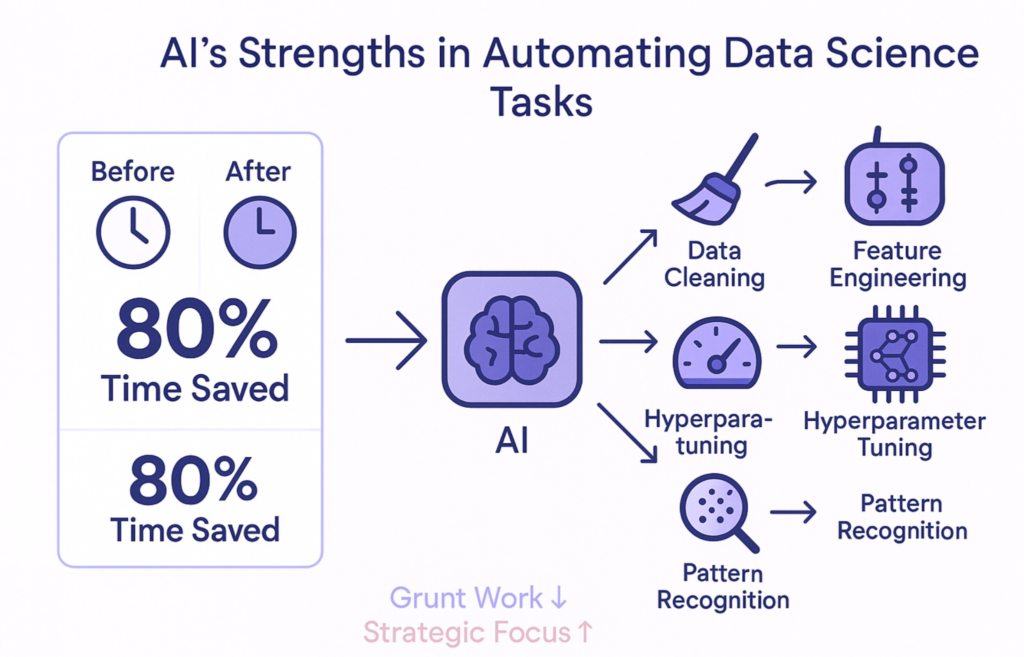
Data scientists, when standing at the edge of an expansive dataset, can feel the looming shadow of time-consuming analysis overhead. But AI – it simply revels in this challenge. Here’s why.
AI algorithms are encoded with an insatiable capacity for speed. They can race through lines of data faster than the blink of an eye, processing unimaginable volumes of information while humans would still be pressing the start button. This uncanny swiftness brings enormous value when dealing with big data, helping organizations tackle increasing data volumes without a hiccup.
Beyond speed, AI algorithms possess a staggering knack for scale. We’re talking about the ability to sieve through zettabytes of data, identifying patterns and correlations that might escape the human gaze. They find subtle connections hidden in oceans of data, which provide valuable insights for decision-making.
Accuracy forms the third pillar of AI’s strength. Machines don’t feel fatigued, they don’t get bored, and they don’t let emotions cloud their judgement. Given the same repetitive task, they will continue to produce results consistently, tirelessly, and without ever inching towards a potential error margin. In eliminating human error, they provide an unmatched level of precision.
Now, imagine the profound impact of these abilities on a data scientist’s routine. Bye-bye mundane tasks. Bye-bye manual scripts running for hours. Instead, they get to engage with the meatier, more intellectually stimulating aspects of their jobs. AI doesn’t force data scientists out, it rather pushes grunt work out of their way. An empowered data scientist is one who harnesses AI’s speed, scale and accuracy to augment their capabilities, not one who fears it.
Humans Unmatched: Beyond AI’s Grasp in Data Science
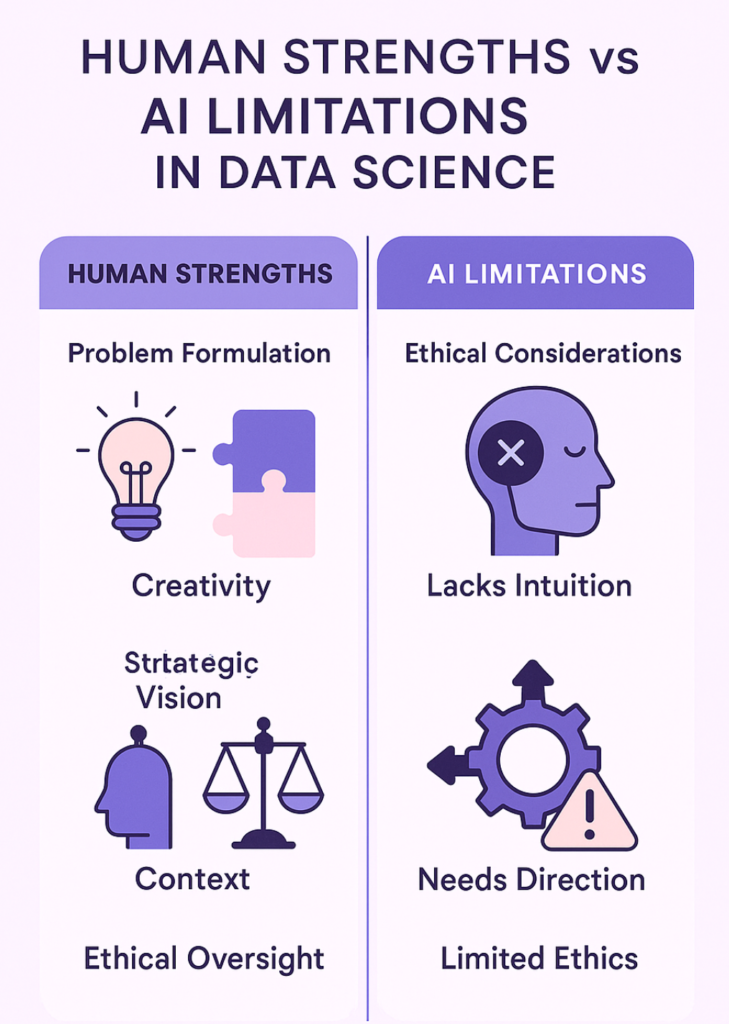
What makes human intelligence indispensable in data science? Let’s explore this by juxtaposing the inherent strengths of humans with the current limitations of AI across different facets of data science.
| Aspect of Data Science | Human Value | AI Current Limitations |
| Problem Formulation | Humans excel in defining the right questions, based on a nuanced understanding of business objectives and customer needs. | AI still struggles to formulate problems autonomously due to a lack of understanding context and business objectives. |
| Ethical Considerations | Humans have the moral compass to weigh the ethical implications of data usage and interpretation. | AI algorithms lack the ability to understand or apply ethical principles and can inadvertently institutionalize bias or discriminatory practices. |
| Domain Expertise & Business Acumen | Humans capably incorporate industry knowledge into data interpretation. | AI is limited in grasping industry nuances and the ability to make domain-specific inferences. |
| Creative Problem Solving | Irreproducible human creativity generates unconventional solutions, thus setting new paths for innovation. | AI, with its deterministic approach, often falls short in ideating out-of-print solutions. |
| Interpretability & Explainability | Humans adeptly decipher complex models’ outcomes and communicate their implications clearly. | AI often produces black box models whose decisions are difficult to explain. |
| Stakeholder Communication | Humans instinctively build relationships and trust, critical for impactful data-driven conversations. | AI yet lacks advanced communication skills to navigate the human landscape of emotions, perception and reaction. |
| Strategic Vision | A uniquely human perspective helps shape data strategies aligned with long-term business vision. | AI lacks perspective outside immediate data patterns and cannot form long-term strategic visions. |
From the above, it becomes evident that the human mind holds a distinct advantage over AI in areas requiring ethical judgement, creative problem solving, and strategic foresight. Despite AI’s impressive strides in data science, it’s clear that it currently falls short in these areas, reinforcing the essential role of human intelligence in the data science journey.
Humans Decipher Unseen Data: A Subtle Advantage Over AI
Interestingly, when it comes to understanding ‘unseen data’ like corporate dynamics, user sociology, or foreseeing market trends, algorithms tend to draw a blank. Not because they lack logic or processing prowess, but because these unseen elements aren’t always available as structured data for AI to comprehend. They exist in the complicated realm of human business intuition, and in the tacit understanding exchanged during a quick chat in the cafeteria line.
Take a data scientist’s ability to predict user needs — it’s not always about identifying patterns with large data sets, it’s often about recognizing a client’s exasperation during a meeting. It’s about hearing the sigh in their voice and understanding the ways in which a product might be falling short.
This is precisely where humans champion AI in data science. They reason, empathize, and hold the fabric of business context together, which is key in data interpretation. Sometimes, the patterns emerging from data are not clear-cut, and this is where a data scientist’s experience and intuition step in. They hypothesize, ponder on vague possibilities, and navigate through the ambiguity to zero in on trends that may not even be apparent yet.
Therefore, despite AI’s enormous speed, scale, and accuracy, these human abilities to discern minutiae around data and comprehend unspoken, often overlooked nuances, truly amplify the value of data science. Their insights shape strategies that are both data-informed and humanely astute. Hence, it’s not about AI replacing humans, but rather about humans learning to leverage AI effectively to streamline their work and increase productivity.
Embracing Augmented Intelligence: The Data Scientist’s New Ally
Let’s take a moment to imagine ‘Data Scientist 2.0’. As Dr. Anya Sharma, lead AI ethicist at DataCorp, puts it, “In the foreseeable future, we’re looking at data scientists forging a powerful partnership with AI. It’s not about one replacing the other, but the two augmenting each other to unlock unprecedented possibilities.”
But to become ‘Data Scientist 2.0’, new skills will be an absolute necessity. It’s not just about the mastery of machine learning theories anymore. Crafting precise prompts to guide AI, understanding the intricacies of MLOps, and navigating through the ethical deployment of AI, these are all emerging as must-haves for the modern data scientist.
So, will AI take over data science as some fear? Not quite. The rise of AI in the realm of data science is akin to how a trusted assistant supports a seasoned professional. In the future, data scientists will lean on sophisticated platforms to streamline complex workflows and manage intricate model deployments.
These platforms, like a trusted aide, allow them to allocate more time for strategic interpretations and ethical implications of their work, instead of getting trudged down in the weeds of repetitive coding or infrastructure management.
In the end, it becomes less of a man versus machine narrative, and more of a man and machine synergy. The ‘Data Scientist 2.0’ will stand tall on this partnership, leveraging the best of both worlds to usher in an era of augmented intelligence in data science.
Six Skills to Master for Future-Ready Data Scientists
1. Ethical AI and Bias Detection: In a world increasingly driven by data, understanding and mitigating potential AI biases becomes necessary. Data scientists must learn to craft algorithms that foster fairness and inclusivity, reducing systemic biases.
2. Advanced Communication and Storytelling: The ability to translate complex data insights into comprehensible messages is an essential skill. It’s about creating narratives that business stakeholders can understand and act upon.
3. Domain Expertise Deepening: Every industry has its unique intricacies. To deliver comprehensive data solutions, cardinal is deepening your domain knowledge. From healthcare to e-commerce, explore how data science intersects with your industry.
4. MLOps and Deployment: Data science doesn’t stop at modeling. Getting models into production, monitoring their performance, and updating them as needed is vital. Hence, knowledge of MLOps and model deployment is essential.
5. Focused Interaction with AI Tools: Enabling AI to do more means learning how to communicate with it effectively. Data scientists must work on crafting precise prompts and integrating AI tools in data workflows to refine output quality.
6. Strategic Business Acumen: Data scientists are not just coders but strategic thinkers. Understanding business needs and aligning data projects to them will create added value, bridging gaps between data, technology, and business.
The subsequent evolution of the data science field will likely demand new competencies. These six areas serve as a compass, pointing data professionals towards the skills they should consider honing. The shift is plain: from coding-heavy tasks to strategist-cum-ethicist roles, encapsulating a broader view of data’s impact.
Action Plan for Data Scientists: AI-Augmented World
As the data science field evolves, a proactive game plan can guide you to not only survive but thrive. Here’s an actionable checklist for data scientists:
- Lifelong learning in AI/ML: Always be learning. Stay updated on AI/ML advancements, it’s a field that never ceases to evolve.
- Soft skills strengthening: Work on your communication and critical thinking skills. They make team collaborations smoother and help to present data findings convincingly.
- Collaboration call: Seek opportunities to collaborate with AI. Mutual growth benefits both humans and machines.
- Ethical importance: Understand your work’s ethical ensnarements. Remember, with great data comes great responsibility.
- Domain expertise: Consider yourself not just a data expert but also a domain expert. The broader your knowledge, the wider the possibilities.
- Networking necessity: Connect with AI/ML professionals. Exchange ideas, learn from their experiences, and stay informed about industry trends.
Take note, this is not a one-off checklist but a continuous process. Data science is a moving target, and staying ahead requires adaptability and a spirit of lifelong learning. Embrace these steps, and you will be well-positioned in the AI-augmented world of tomorrow.
Looking Ahead: Data Science Harnesses AI, Not the Other Way Around
Instead of viewing AI as a disruptive force set to replace data scientists, consider it an empowering tool that liberates them from tedious tasks. AI’s ability to automate is undisputed, but it lacks the human touch,empathy, creativity, and ethical judgement,that is quintessential to data science.
Thus, the emerging narrative is not about job loss, but rather job augmentation and skill development. Human-AI collaboration holds great promise for professionals and the industry alike; it unveils an exciting future where data scientists are elevated to roles of strategic importance, underpinned by ethical computing and domain expertise. The future belongs to those who embrace this shift, recognize AI’s limitations, and wield its capabilities with skill and wisdom.
Change the Conversation: AI as Opportunity, Not Threat
Forget the ‘take over’; think ‘transformation’. Shifting the conversation in this manner steers us in the right direction. Encouraging data professionals to embrace AI as an avenue to elevate their roles supports a higher strategic input. The reality of AI’s impact is less about replacement and more about the evolution of the data scientist role in the rapidly changing tech landscape.